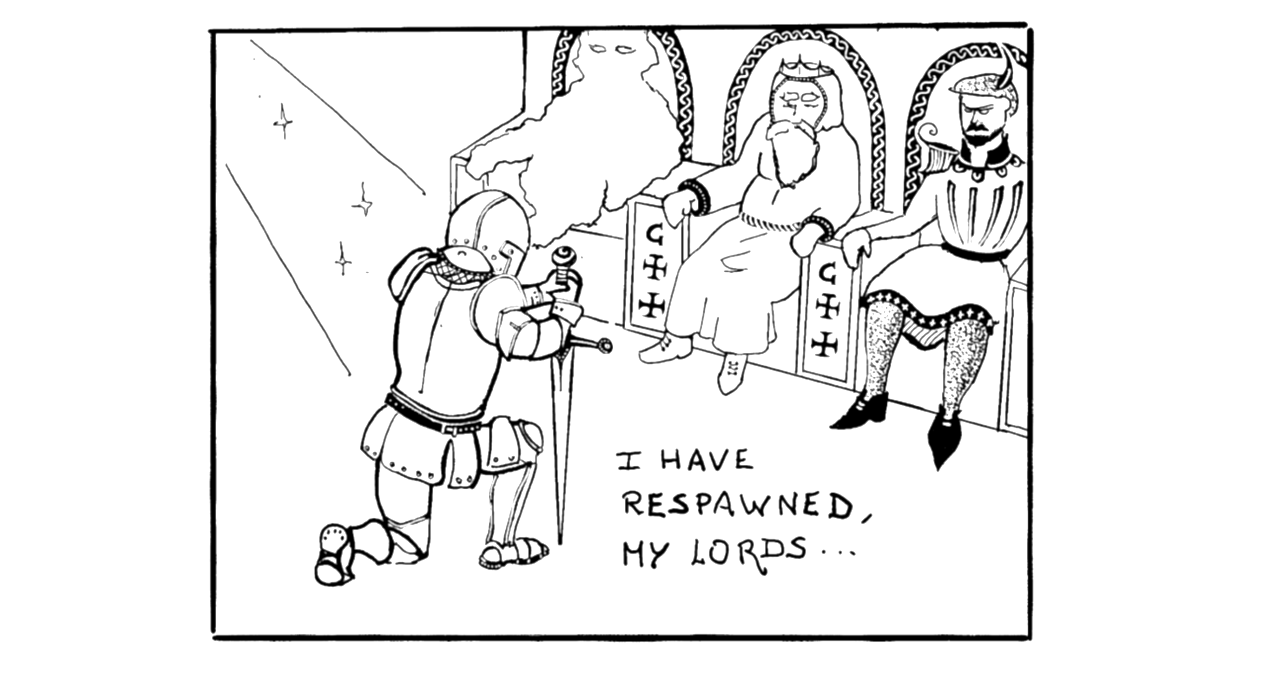
New Player Joined the Alliance
How a frustrated user ended up revitalizing Boost.Graph
In January 2026 I joined the C++ Alliance to contribute and revitalize Boost.Graph, one of the oldest libraries in one of the largest C++ ecosystems. We think about the “open source contributor journey” as starting with a first pull request. It does not. Mine started years before, as a frustrated user cursing at a library at 2am. If you’re stuck on Boost.Graph right now, or Boost.ICL or Boost.Whatever, and you hate it, good. Very good. That’s precisely where I was, and it’s the actual beginning of the story. You never know what flowers grow from the trenches.
So how does a geneticist end up repairing a 28-year-old graph library? Not on purpose.
I started using Boost during my PhD in genetics, for C++ simulations. I was building Quetzal-CoaTL, a template library for population genetics. Spatial graphs, gene genealogies, species trees, population networks… graphs everywhere. Eeeeeeverywheeeere. Population genetics is like a matriochka carved into the tree of life itself: it recurses and doesn’t care when you curse back.
Boost is a C++ ecosystem as vast as my French taste for long, heavy sentences. It’s a luxuriant open-world map of ~165 C++ libraries, all open source, peer-reviewed, portable and free. It largely influenced the standard: simply think about Boost.Tuple and std::tuple, or Boost.Lambda and its standard equivalent. And it’s not over: it still acts like a fertile ground where experts come and experiment with new designs and implementations, and hand users what the standard does not/will not/should not cover. Think Boost.Asio, Boost.URL and … Boost.Graph.
Around 2018 I floated my library on the Boost mailing list as a possible candidate for inclusion. The answer was a clear no: too niche, too small, too poorly designed. For a PhD student who had carried his baby for years before showing it to the world, it hurt (honestly that bounce kept me away from the mailing list for quite some time). I still remember Vinnie Falco, now president of the C++ Alliance, saying something like “jesus, 6 levels of nested namespace…”. What? WHAT? Is he being mean to my most cherished quetzal::demography::dispersal::gaussian::parameter class? How dare they? I was young. Retrospectively though, people were extremely kind to me given the quality of the code I was presenting them with tears of pride in my eyes. As goes the short French saying:
The beginner, for his part, has no idea how much he fails to grasp; he takes more pride in his first successes than he is aware of the vastness of what he does not know. Once he progresses, however, once what he knows begins to grow, he starts to perceive everything his knowledge still lacks. He who knows little is also ignorant of very little. (Roger-Pol Droit)
(French “short.”)
I carried my grief away from the mailing list. But I kept using Boost, and in 2022 I reached out to Jeremy Murphy because I wanted to use Boost.Graph to represent genetic trees. I ended up working off his fork to experiment with BGL while juggling the move from academia into industry in Seattle. I barely knew what I was doing with this very generic code and AI was not there yet to help me through the layers of abstractions.
But some Boost people were on Stack Overflow helping poor souls getting their first BGL code to compile. If you haven’t had the occasion to interact with @sehe, just know the guy is a legend. My favorite memory is a lonely December 24 in Seattle, an ocean and a continent from family, spent fighting Boost.Graph to grow a random spanning tree on a random graph. I went to sleep losing. Then look at the Christmas present @sehe left me on the 25th: the mad quality and completeness of this answer. He became another C++ hero to me. I only understood the full picture years later: Seth had joined the C++ Alliance in April 2022 “to be more effective at removing barriers to entrance for people making similar journeys through C++ and Boost in particular”. So that Christmas answer wasn’t luck or charity. It was him, on mission, removing a barrier for a stranger he’d never meet.
That’s the part most people don’t see in a “contributor journey”: there are years of being a stuck, frustrated user before the first PR. We try, we fail, we rage, we want to quit, then we see magicians compiling flying rabbits out of their hats, and … we get inspired. That’s when I began thinking about contributing more to Boost and giving back a bit of its magic.
The C++ Alliance is a charity quietly sustaining a huge chunk of the C++ world: it funds Boost, runs the Slack where many of the language’s experts hang out, pushes proposals into the C++ standard, and pays to teach the language at conferences. A private endowment and a small crew of unusually gifted people geared towards one quest: make C++ fun and reachable. Which, given that I spent a Christmas Eve being defeated by one of Boost’s libraries, is a quest I have strong feelings about.
Things shifted socially first. Language friction is real: how many brilliant engineers stay hidden behind a few broken English sentences? Even after years in the US I struggled to be taken seriously (even when angry) because my accent is “so cute”. As my English loosened up, and because I was living 9 hours behind France, I drifted from the French C++ scene into the Cpplang Slack #boost channel. In April 2023 Vinnie reached out just to get to know me. That mattered more than it sounds: it’s the kind of low-stakes contact that makes a big project feel human.
In September 2024 he asked me to review the Boost Asset Stewardship proposal, one of the most political proposals in C++ open source. I walked in skeptical and ended up supporting it.
In April 2025, Matt Borland, an Alliance member and maintainer of Boost.Math, offered me the review manager role for Boost.Bloom. Joaquín, the author, was impressively responsive and it ran as cleanly as a review can. Joaquín then baited me into a small council to redraft Boost’s mission: we never found a third member and shelved it, but those conversations still feed my work, and today we achieved several of their intended objectives.
There is something deeply ethical in cooperating with an open source organization like the Alliance. They are basically using (cynics would say wasting) resources to create wealth for other people and organizations: there is no concept of profit in those settings, the scale is bigger than that. And from my conversations with Matt, Joaquín, Jeremy, and all the reviewers, the work ethic is strong: it’s not a problem if something takes months to ship as long as it’s so excellent it can last decades. You see, it’s much less about feature rush than stability and honoring an old design that was carefully crafted. And outside the Alliance’s small staff, most maintainers work in their free time: things like urgency don’t really operate here. I felt something so humanist and chevaleresque in this whole cavalcade. It was like having worked in cheap construction for years and suddenly discovering that a secret society was still building Roman architecture in the background.
In August I hung out with Matt in Paris, then again in December in Strasbourg, and somewhere between two cups of Glühwein and Gewürztraminer I knew I wanted to join the crew.
So a week later I approached the C++ Alliance with a concrete proposal: revitalize Boost.Graph, which was showing its age. For example, its documentation was a wall of raw HTML: if you haven’t written a C++ source reference in HTML with escape characters and all, please try, it’s a rare pleasure worth an hour driving in Paris streets in summer without AC on. I surprised myself with how many ideas I had, both technical and social. Because many Boost.Graph’s problems don’t live in the code, they live in communication: documentation, pedagogy, signaling, process, community. You can have a mountain of genius code, and a dead project at the same time. My mantra became “lower the bar”. The Alliance said yes.
So, what did I just sign up for? Boost.Graph is an immensely flexible framework to represent networks and their algorithms. There is nothing remotely similar to it out there. It’s also old: born in 1998 as the Generic Graph Component Library at Notre Dame (Jeremy Siek, Lie-Quan Lee, Andrew Lumsdaine), and it has been generating graphs for 28 years. A relic, yes, but a living one, whose generic design still feels years ahead of its peers. As phasesmith Karax says of the Spear of Adun arkship in StarCraft II:
A marvel of Khalai engineering, and the last of the three great arkships… There is much to learn about this vessel. Its technology is ancient, yet highly advanced. We are aboard a relic from a glorious time when our culture shined as a constellation.
That’s exactly what it felt like to come aboard in the dark times of vibe-coded, feature-rushed, enshittified projects.
So my mission in the game is “simple”: revitalize the Boost.Graph Library and act as a support for Jeremy Murphy, our Principal Maintainer, while we repair the ship after 28 years in user space. The guy solo carried the project for 10 years, so I trust him. I used to be a main support playing League of Legends, so being a support tracks with my life philosophy. Whoever stepped through the BGL codebase once could be caught vituperating that we need a jungler, not an enchanter. Idk, BGL is no mere monster camp, maybe we need both? Karma casts Renewal on BGL.
Since January I’ve landed three big PRs: a generic Louvain community detection algorithm, a modernized GitHub integration, and a full documentation rewrite with Antora+AsciiDoc and modern C++14 examples (browse the new docs). I turned on the project’s GitHub Discussions so users can chime in without the technical pressure of an issue template. And I co-organized with Jeremy Murphy the first Boost.Graph workshop. It was a testament to the diversity of people and tech that rely on us and it gave us our 2026 roadmap. It also made me more confident in my own ability to summon the spirits of community and collaboration. Add to that a conference talk on community detection with Boost.Graph, and a seat in the standardization discussions about graphs in C++.
Long term, I want to circle back to my roots and propose a formal Boost.Genetics, with parsers and simulation engines for genetic data. The narrative arc in one line: genetics gave me the problem, Boost.Graph gave me the tool, and modernizing the tool is the prerequisite for finally writing the library I wanted to write inf the first place.
So let me come back to you, the one stuck on Boost.Whatever at 2am, cursing the compiler, burning tokens faster than Brand with a Liandry burns lifebars, on the verge of quitting. I see you. I was you. Somebody once spent their Christmas pulling a flying rabbit out of a hat just so my code would compile, and it subtly changed the trajectory of my whole life (without me even realizing: nice trick, Life). Now it’s my turn to hold the door open and ease the crossing. The new documentation is built for exactly the person you are right now. The #boost channel on the Cpplang Slack is full of people who will help you (I’m one of them). And if you hit a wall in BGL, open an issue: I read them, I answer them, and your friction is the best map I have for what to fix next. Come play!
Update, November 2026. I drafted this in early July. Since then, Boost.Graph has dropped a long list of dependencies on other Boost libraries, its test suite gained sanitizers and coverage reports, visitors can now carry state through the main traversal algorithms, and I became a maintainer of Boost.PropertyMap. More on each of these soon.
My work on Boost.Graph is supported by the C++ Alliance. Opinions are my own.